
Why neutrinos
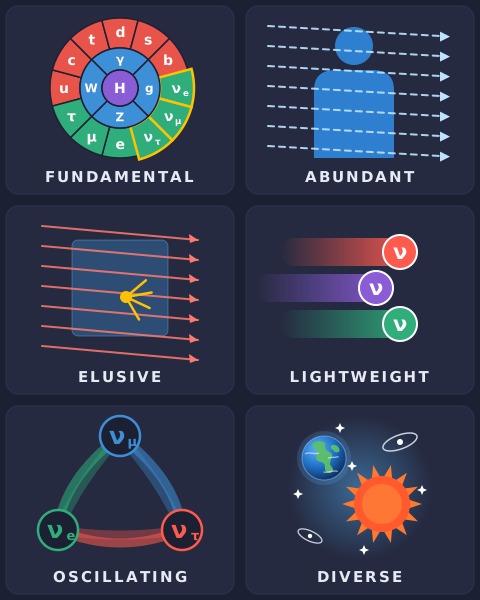
Neutrinos are fundamental particles of the Standard Model: electrically neutral, almost massless, and interacting only through the weak force. They are the second most abundant particle in the Universe after photons, they come in three flavours (electron, muon and tau), and they change from one flavour into another as they travel. That oscillation, which implies they have mass, is still one of the clearest signs of physics beyond the Standard Model.
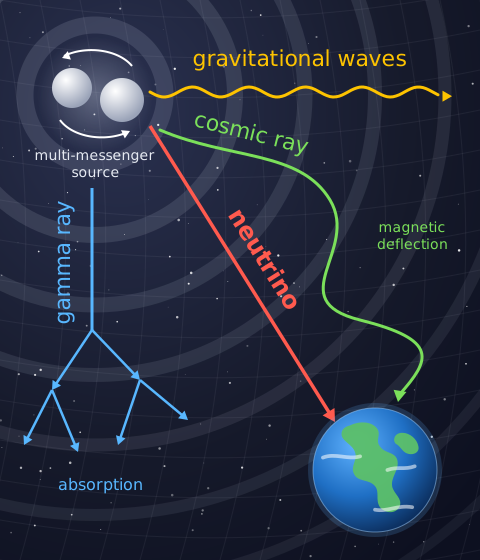
The property that makes neutrinos hard to detect is the one that makes them valuable to astronomers. Photons are absorbed by dust and gas or by the background radiation between galaxies; charged cosmic rays are bent by magnetic fields and arrive from directions that no longer point to their source. Neutrinos do neither. They escape from the dense cores of the most violent objects in the Universe, such as active galactic nuclei, gamma-ray bursts, supernovae and merging neutron stars, and travel to us in straight lines. Together with light, cosmic rays and gravitational waves, they are one of the four messengers of multi-messenger astronomy.
The sources span more than twenty orders of magnitude in energy, from the relic neutrinos of the Big Bang and those produced in the Sun, through reactors and the atmosphere, up to the astrophysical and cosmogenic neutrinos at TeV, PeV and higher energies. It is this high-energy end that neutrino telescopes are built for.
Neutrino telescopes
Because neutrinos interact so rarely, a telescope that wants to see the few that come from the cosmos needs an enormous target, about a cubic kilometre in size, that is also transparent, so the faint light from an interaction can be recorded. Nature provides it in three places: the Antarctic ice, deep lakes and the deep sea.
| IceCube | South Pole. A cubic kilometre of Antarctic ice instrumented with 5160 optical modules on 86 strings at depths of 1450–2450 m. Complete since 2010, and the first to detect high-energy neutrinos from beyond the Solar System. |
|---|---|
| Baikal-GVD | Lake Baikal, Siberia. Strings of optical modules suspended in the fresh water of the world’s deepest lake at around 1 km depth, built cluster by cluster towards cubic-kilometre size. |
| KM3NeT | Mediterranean Sea. Two deep-sea detectors, ARCA off Sicily and ORCA off southern France, under construction and already taking data. |
| ANTARES | Off Toulon, France, 2008–2022. The first neutrino telescope in the deep sea, and the predecessor of KM3NeT. |
| Next generation | IceCube-Gen2 in Antarctica, P-ONE in the Pacific off Canada and TRIDENT in the South China Sea are in preparation. |
The detectors complement each other. A telescope looks best through the Earth, which filters out everything except neutrinos, so IceCube at the South Pole sees the northern sky most clearly, while KM3NeT and Baikal-GVD in the Northern Hemisphere look at the southern sky, including the centre of our Galaxy. Together they form the Global Neutrino Network.
The KM3NeT detector
KM3NeT (Cubic Kilometre Neutrino Telescope) is a research infrastructure in the Mediterranean Sea, built and operated by the KM3NeT Collaboration: around 360 scientists and engineers from more than 60 institutes in over 20 countries. Slovakia is represented by the Institute of Experimental Physics of the Slovak Academy of Sciences (IEP SAS) in Košice and by Comenius University in Bratislava.
| Sites | ARCA off Sicily (3450 m deep) and ORCA off Toulon, France (2450 m deep) |
|---|---|
| Detection unit | A vertical line anchored to the sea floor and held up by a buoy, carrying 18 optical modules |
| Optical module | A 17-inch pressure-resistant glass sphere housing 31 small 3-inch photomultiplier tubes, which tell the direction of the light as well as its arrival time |
| Status (October 2026) | ARCA: 62 detection units, 54% of the first building block and about 27% of the full detector. ORCA: 44 detection units, about 38% of the full detector. Construction continues line by line. |
The detectors take data while construction continues.
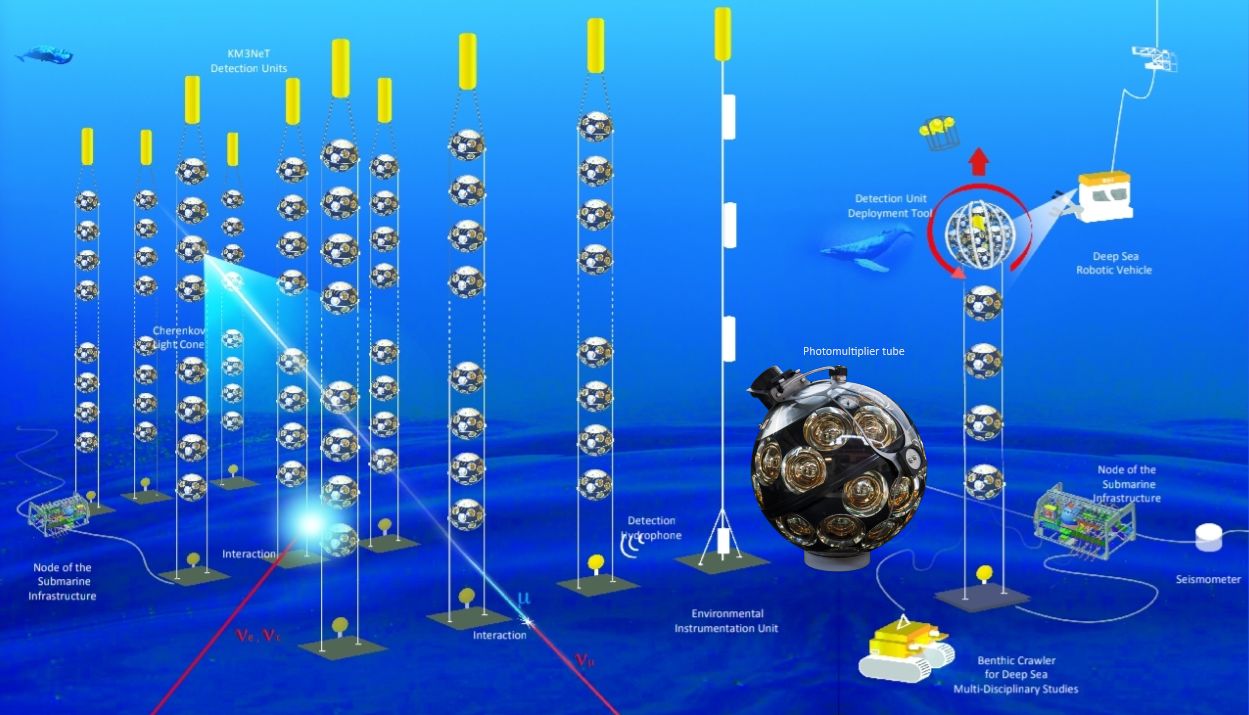
The light sensors themselves are photomultiplier tubes (PMTs), which can turn a single photon into a measurable electrical signal. When a photon hits the thin photocathode on the inside of the glass window, it knocks out an electron through the photoelectric effect. Inside the tube, this electron is multiplied about a million times, which gives a short electrical pulse.
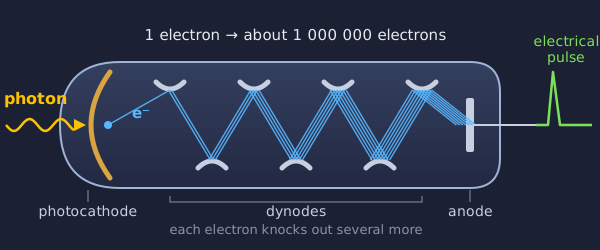
KM3NeT uses a different design from most earlier telescopes. Instead of one large PMT, each optical module holds 31 small 3-inch tubes looking in different directions. This tells the detector which way the light came from, lets it separate one photon from several arriving at once, and means a single failed tube costs only a small part of the module.
How it detects a neutrino
A neutrino is never seen directly. Very rarely, one of them interacts with a nucleus in the seawater or the rock below and produces charged particles, and these give it away.
The hardest part is the background. Cosmic rays hitting the top of the atmosphere produce showers of secondary particles, and among them are muons energetic enough to reach the detector even through kilometres of water, as well as atmospheric neutrinos. Downgoing atmospheric muons outnumber neutrino events by about a million to one. This is why the telescope looks down: only neutrinos can cross the whole Earth, so an upgoing track is a strong sign of a neutrino.
Two detectors: ARCA and ORCA
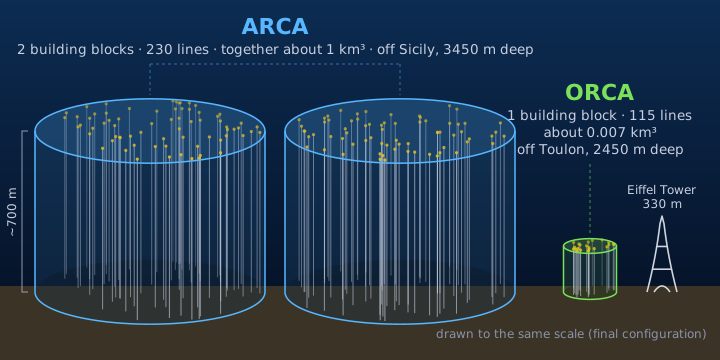
KM3NeT builds two detectors with the same technology. They differ mainly in how far apart the sensors are, which decides the energies each one is best at.
| ARCA | Astroparticle Research with Cosmics in the Abyss. Lines about 90 m apart, each about 700 m tall. Each of its two building blocks covers about half a cubic kilometre, together roughly one cubic kilometre. Built for high-energy cosmic neutrinos (TeV to PeV and beyond) and the search for their sources. |
|---|---|
| ORCA | Oscillation Research with Cosmics in the Abyss. Lines only about 20 m apart and about 200 m tall, a far smaller but densely instrumented volume. Built for atmospheric neutrinos of a few GeV, to study oscillations and determine the neutrino mass ordering. |
Why simulations matter
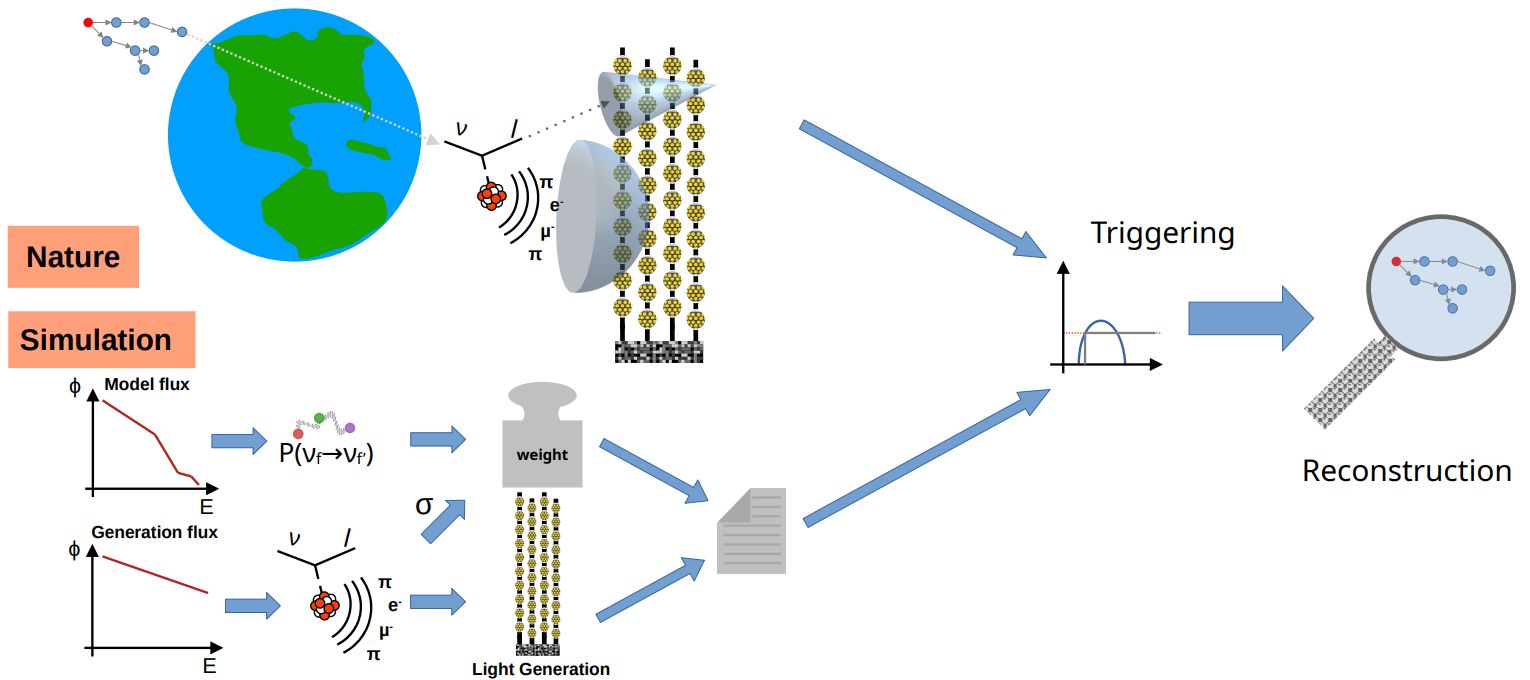
A neutrino telescope cannot be calibrated with a known neutrino beam. Every measurement, whether a source discovery, an oscillation parameter or an energy spectrum, rests on a comparison between what the detector records and what it should record if our understanding of the physics and the detector is correct. That expectation comes from Monte Carlo simulation.
The KM3NeT simulation chain follows a particle from its creation to a reconstructed event: event generation (the neutrino or muon and its interaction, with gSeaGen and GENIE), lepton propagation through water and rock (PROPOSAL, MUSIC, TAUSIC), light generation and propagation to the optical modules, the detector response and triggering, and finally the same reconstruction that is applied to real data. Large samples of simulated events are weighted to physical flux models and compared to data.
Our contribution: cosmic rays and CORSIKA in the simulation chain
The atmospheric muons and neutrinos that dominate the data are produced by cosmic rays: protons and heavier nuclei that hit the atmosphere and start extensive air showers. They have to be simulated as accurately as the signal. Comparisons between data and simulation in ARCA show discrepancies in this atmospheric component, which points to how the cosmic-ray showers and their products are modelled.
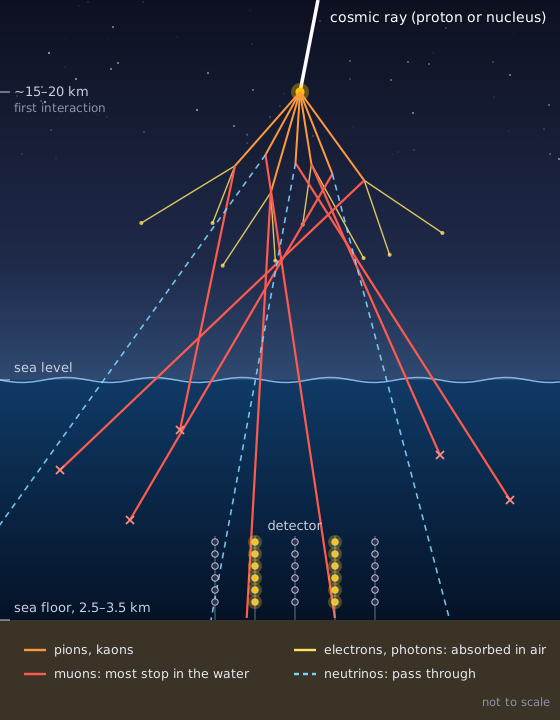
The standard tool for air showers is CORSIKA (COsmic Ray SImulations for KAscade), a Monte Carlo code that follows a primary cosmic ray through its interactions in the atmosphere and tracks the secondary particles down to ground level. It is used by IceCube, the Pierre Auger Observatory and many other experiments, and gives a detailed description of the muons and neutrinos produced in each shower.
Hajnalka Haneszová is connecting CORSIKA to the KM3NeT event generator gSeaGen, so that air-shower particles enter the standard simulation chain in the same way as every other event. The work has two parts:
- CORSIKA 7, the established Fortran version used by most experiments today: processing the atmospheric neutrinos (and muons) it produces at sea level and propagating them through the water to the detector.
- CORSIKA 8, the new, modular C++ generation of the code: integrating it into gSeaGen so that KM3NeT can use it as it becomes the new standard.
The implementation is under way and in testing.
The goal is a more realistic description of the atmospheric background, and with it a better agreement between data and simulation, which every KM3NeT analysis depends on.
The next steps are systematic comparisons of the improved simulation with ARCA and ORCA data, and in the longer term the use of the large sample of atmospheric muons recorded by KM3NeT to study cosmic rays themselves.
People
Ing. Hajnalka Haneszová, PhD student: simulation software, CORSIKA 7 and CORSIKA 8 in gSeaGen.
RNDr. Blahoslav Pastirčák, CSc., supervisor.